Technology, medicine, and mathematics
Technology
In technology, medicine, and mathematics, ancient Egypt achieved a relatively high standard of productivity and sophistication. Traditional empiricism, as evidenced by the Edwin Smith and Ebers papyri (c. 1600 BC), is first credited to Egypt. The Egyptians created their own alphabet and decimal system.
Faience and glass
Even before the Old Kingdom, the ancient Egyptians had developed a glassy material known as faience, which they treated as a type of artificial semi-precious stone. Faience is a non-clay ceramic made of silica, small amounts of lime and soda, and a colorant, typically copper. The material was used to make beads, tiles, figurines, and small wares. Several methods can be used to create faience, but typically production involved application of the powdered materials in the form of a paste over a clay core, which was then fired. By a related technique, the ancient Egyptians produced a pigment known as Egyptian blue, also called blue frit, which is produced by fusing (or sintering) silica, copper, lime, and an alkali such as natron. The product can be ground up and used as a pigment.
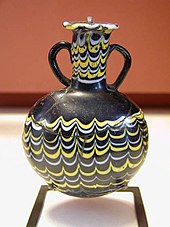
The ancient Egyptians could fabricate a wide variety of objects from glass with great skill, but it is not clear whether they developed the process independently. It is also unclear whether they made their own raw glass or merely imported pre-made ingots, which they melted and finished. However, they did have technical expertise in making objects, as well as adding trace elements to control the color of the finished glass. A range of colors could be produced, including yellow, red, green, blue, purple, and white, and the glass could be made either transparent or opaque.
Medicine
The medical problems of the ancient Egyptians stemmed directly from their environment. Living and working close to the Nile brought hazards from malaria and debilitating schistosomiasis parasites, which caused liver and intestinal damage. Dangerous wildlife such as crocodiles and hippos were also a common threat. The lifelong labors of farming and building put stress on the spine and joints, and traumatic injuries from construction and warfare all took a significant toll on the body. The grit and sand from stone-ground flour abraded teeth, leaving them susceptible to abscesses (though caries were rare).
The diets of the wealthy were rich in sugars, which promoted periodontal disease. Despite the flattering physiques portrayed on tomb walls, the overweight mummies of many of the upper class show the effects of a life of overindulgence. Adult life expectancy was about 35 for men and 30 for women, but reaching adulthood was difficult as about one-third of the population died in infancy.c
Ancient Egyptian physicians were renowned in the ancient Near East for their healing skills, and some, such as Imhotep, remained famous long after their deaths. Herodotus remarked that there was a high degree of specialization among Egyptian physicians, with some treating only the head or the stomach, while others were eye-doctors and dentists. Training of physicians took place at the Per Ankh or "House of Life" institution, most notably those headquartered in Per-Bastet during the New Kingdom and at Abydos and Saïs in the Late period. Medical papyri show empirical knowledge of anatomy, injuries, and practical treatments.
Wounds were treated by bandaging with raw meat, white linen, sutures, nets, pads, and swabs soaked with honey to prevent infection, while opium, thyme, and belladona were used to relieve pain. The earliest records of burn treatment describe burn dressings that use the milk from mothers of male babies. Prayers were made to the goddess Isis. Moldy bread, honey, and copper salts were also used to prevent infection from dirt in burns. Garlic and onions were used regularly to promote good health and were thought to relieve asthma symptoms. Ancient Egyptian surgeons stitched wounds, set broken bones, and amputated diseased limbs, but they recognized that some injuries were so serious that they could only make the patient comfortable until death occurred.
Maritime technology
 | It has been suggested that portions of this section be split out into another article titled Ancient_Egyptian_technology#Navigation_and_ship_building. (Discuss) (February 2020) |
Early Egyptians knew how to assemble planks of wood into a ship hull and had mastered advanced forms of shipbuilding as early as 3000 BC. The Archaeological Institute of America reports that the oldest planked ships known are the Abydos boats. A group of 14 discovered ships in Abydos were constructed of wooden planks "sewn" together. Discovered by Egyptologist David O'Connor of New York University, woven straps were found to have been used to lash the planks together, and reeds or grass stuffed between the planks helped to seal the seams. Because the ships are all buried together and near a mortuary belonging to Pharaoh Khasekhemwy, originally they were all thought to have belonged to him, but one of the 14 ships dates to 3000 BC, and the associated pottery jars buried with the vessels also suggest earlier dating. The ship dating to 3000 BC was 75 feet (23 m) long and is now thought to perhaps have belonged to an earlier pharaoh, perhaps one as early as Hor-Aha.
Early Egyptians also knew how to assemble planks of wood with treenails to fasten them together, using pitch for caulking the seams. The "Khufu ship", a 43.6-metre (143 ft) vessel sealed into a pit in the Giza pyramid complex at the foot of the Great Pyramid of Giza in the Fourth Dynasty around 2500 BC, is a full-size surviving example that may have filled the symbolic function of a solar barque. Early Egyptians also knew how to fasten the planks of this ship together with mortise and tenon joints.
Large seagoing ships are known to have been heavily used by the Egyptians in their trade with the city states of the eastern Mediterranean, especially Byblos (on the coast of modern-day Lebanon), and in several expeditions down the Red Sea to the Land of Punt. In fact one of the earliest Egyptian words for a seagoing ship is a "Byblos Ship", which originally defined a class of Egyptian seagoing ships used on the Byblos run; however, by the end of the Old Kingdom, the term had come to include large seagoing ships, whatever their destination.
In 2011, archaeologists from Italy, the United States, and Egypt excavating a dried-up lagoon known as Mersa Gawasis have unearthed traces of an ancient harbor that once launched early voyages like Hatshepsut's Punt expedition onto the open ocean. Some of the site's most evocative evidence for the ancient Egyptians' seafaring prowess include large ship timbers and hundreds of feet of ropes, made from papyrus, coiled in huge bundles. In 2013 a team of Franco-Egyptian archaeologists discovered what is believed to be the world's oldest port, dating back about 4500 years, from the time of King Cheops on the Red Sea coast near Wadi el-Jarf (about 110 miles south of Suez).
In 1977, an ancient north–south canal dating to the Middle Kingdom of Egypt was discovered extending from Lake Timsah to the Ballah Lakes. It was dated to the Middle Kingdom of Egypt by extrapolating dates of ancient sites constructed along its course.d
Mathematics
The earliest attested examples of mathematical calculations date to the predynastic Naqada period, and show a fully developed numeral system.e The importance of mathematics to an educated Egyptian is suggested by a New Kingdom fictional letter in which the writer proposes a scholarly competition between himself and another scribe regarding everyday calculation tasks such as accounting of land, labor, and grain. Texts such as the Rhind Mathematical Papyrus and the Moscow Mathematical Papyrus show that the ancient Egyptians could perform the four basic mathematical operations—addition, subtraction, multiplication, and division—use fractions, calculate the areas of rectangles, triangles, and circles and compute the volumes of boxes, columns and pyramids. They understood basic concepts of algebra and geometry, and could solve simple sets of simultaneous equations.
| ||
| 2⁄3 in hieroglyphs |
|---|

Mathematical notation was decimal, and based on hieroglyphic signs for each power of ten up to one million. Each of these could be written as many times as necessary to add up to the desired number; so to write the number eighty or eight hundred, the symbol for ten or one hundred was written eight times respectively. Because their methods of calculation could not handle most fractions with a numerator greater than one, they had to write fractions as the sum of several fractions. For example, they resolved the fraction two-fifths into the sum of one-third + one-fifteenth. Standard tables of values facilitated this. Some common fractions, however, were written with a special glyph—the equivalent of the modern two-thirds is shown on the right.
Ancient Egyptian mathematicians knew the Pythagorean theorem as an empirical formula. They were aware, for example, that a triangle had a right angle opposite the hypotenuse when its sides were in a 3–4–5 ratio. They were able to estimate the area of a circle by subtracting one-ninth from its diameter and squaring the result:
- Area ≈ (8⁄9)D2 = (256⁄81)r2 ≈ 3.16r2,
a reasonable approximation of the formula πr2.
The golden ratio seems to be reflected in many Egyptian constructions, including the pyramids, but its use may have been an unintended consequence of the ancient Egyptian practice of combining the use of knotted ropes with an intuitive sense of proportion and harmony.


Comments
Post a Comment