Culture

Daily life
Most ancient Egyptians were farmers tied to the land. Their dwellings were restricted to immediate family members, and were constructed of mudbrick designed to remain cool in the heat of the day. Each home had a kitchen with an open roof, which contained a grindstone for milling grain and a small oven for baking the bread. Ceramics served as household wares for the storage, preparation, transport, and consumption of food, drink, and raw materials. Walls were painted white and could be covered with dyed linen wall hangings. Floors were covered with reed mats, while wooden stools, beds raised from the floor and individual tables comprised the furniture.
The ancient Egyptians placed a great value on hygiene and appearance. Most bathed in the Nile and used a pasty soap made from animal fat and chalk. Men shaved their entire bodies for cleanliness; perfumes and aromatic ointments covered bad odors and soothed skin. Clothing was made from simple linen sheets that were bleached white, and both men and women of the upper classes wore wigs, jewelry, and cosmetics. Children went without clothing until maturity, at about age 12, and at this age males were circumcised and had their heads shaved. Mothers were responsible for taking care of the children, while the father provided the family's income.
Music and dance were popular entertainments for those who could afford them. Early instruments included flutes and harps, while instruments similar to trumpets, oboes, and pipes developed later and became popular. In the New Kingdom, the Egyptians played on bells, cymbals, tambourines, drums, and imported lutes and lyres from Asia. The sistrum was a rattle-like musical instrument that was especially important in religious ceremonies.
The ancient Egyptians enjoyed a variety of leisure activities, including games and music. Senet, a board game where pieces moved according to random chance, was particularly popular from the earliest times; another similar game was mehen, which had a circular gaming board. “Hounds and Jackals” also known as 58 holes is another example of board games played in ancient Egypt. The first complete set of this game was discovered from a Theban tomb of the Egyptian pharaoh Amenemhat IV that dates to the 13th Dynasty. Juggling and ball games were popular with children, and wrestling is also documented in a tomb at Beni Hasan. The wealthy members of ancient Egyptian society enjoyed hunting, fishing, and boating as well.
The excavation of the workers' village of Deir el-Medina has resulted in one of the most thoroughly documented accounts of community life in the ancient world, which spans almost four hundred years. There is no comparable site in which the organization, social interactions, and working and living conditions of a community have been studied in such detail.
Cuisine
Egyptian cuisine remained remarkably stable over time; indeed, the cuisine of modern Egypt retains some striking similarities to the cuisine of the ancients. The staple diet consisted of bread and beer, supplemented with vegetables such as onions and garlic, and fruit such as dates and figs. Wine and meat were enjoyed by all on feast days while the upper classes indulged on a more regular basis. Fish, meat, and fowl could be salted or dried, and could be cooked in stews or roasted on a grill.
Architecture
The architecture of ancient Egypt includes some of the most famous structures in the world: the Great Pyramids of Giza and the temples at Thebes. Building projects were organized and funded by the state for religious and commemorative purposes, but also to reinforce the wide-ranging power of the pharaoh. The ancient Egyptians were skilled builders; using only simple but effective tools and sighting instruments, architects could build large stone structures with great accuracy and precision that is still envied today.
The domestic dwellings of elite and ordinary Egyptians alike were constructed from perishable materials such as mudbricks and wood, and have not survived. Peasants lived in simple homes, while the palaces of the elite and the pharaoh were more elaborate structures. A few surviving New Kingdom palaces, such as those in Malkata and Amarna, show richly decorated walls and floors with scenes of people, birds, water pools, deities and geometric designs. Important structures such as temples and tombs that were intended to last forever were constructed of stone instead of mudbricks. The architectural elements used in the world's first large-scale stone building, Djoser's mortuary complex, include post and lintel supports in the papyrus and lotus motif.
The earliest preserved ancient Egyptian temples, such as those at Giza, consist of single, enclosed halls with roof slabs supported by columns. In the New Kingdom, architects added the pylon, the open courtyard, and the enclosed hypostyle hall to the front of the temple's sanctuary, a style that was standard until the Greco-Roman period. The earliest and most popular tomb architecture in the Old Kingdom was the mastaba, a flat-roofed rectangular structure of mudbrick or stone built over an underground burial chamber. The step pyramid of Djoser is a series of stone mastabas stacked on top of each other. Pyramids were built during the Old and Middle Kingdoms, but most later rulers abandoned them in favor of less conspicuous rock-cut tombs. The use of the pyramid form continued in private tomb chapels of the New Kingdom and in the royal pyramids of Nubia.
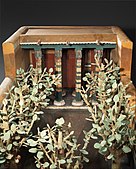
Model of a household porch and garden, c. 1981–1975 BC
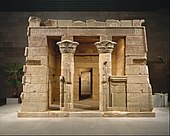
The Temple of Dendur, completed by 10 BC, made of aeolian sandstone, temple proper: height: 6.4 m, width: 6.4 m; length: 12.5 m, in the Metropolitan Museum of Art (New York City)

The well preserved Temple of Isis from Philae is an example of Egyptian architecture and architectural sculpture

Illustration of various types of capitals, drawn by the Egyptologist Karl Richard Lepsius


Art
The ancient Egyptians produced art to serve functional purposes. For over 3500 years, artists adhered to artistic forms and iconography that were developed during the Old Kingdom, following a strict set of principles that resisted foreign influence and internal change. These artistic standards—simple lines, shapes, and flat areas of color combined with the characteristic flat projection of figures with no indication of spatial depth—created a sense of order and balance within a composition. Images and text were intimately interwoven on tomb and temple walls, coffins, stelae, and even statues. The Narmer Palette, for example, displays figures that can also be read as hieroglyphs. Because of the rigid rules that governed its highly stylized and symbolic appearance, ancient Egyptian art served its political and religious purposes with precision and clarity.
Ancient Egyptian artisans used stone as a medium for carving statues and fine reliefs, but used wood as a cheap and easily carved substitute. Paints were obtained from minerals such as iron ores (red and yellow ochres), copper ores (blue and green), soot or charcoal (black), and limestone (white). Paints could be mixed with gum arabic as a binder and pressed into cakes, which could be moistened with water when needed.
Pharaohs used reliefs to record victories in battle, royal decrees, and religious scenes. Common citizens had access to pieces of funerary art, such as shabti statues and books of the dead, which they believed would protect them in the afterlife. During the Middle Kingdom, wooden or clay models depicting scenes from everyday life became popular additions to the tomb. In an attempt to duplicate the activities of the living in the afterlife, these models show laborers, houses, boats, and even military formations that are scale representations of the ideal ancient Egyptian afterlife.
Despite the homogeneity of ancient Egyptian art, the styles of particular times and places sometimes reflected changing cultural or political attitudes. After the invasion of the Hyksos in the Second Intermediate Period, Minoan-style frescoes were found in Avaris. The most striking example of a politically driven change in artistic forms comes from the Amarna Period, where figures were radically altered to conform to Akhenaten's revolutionary religious ideas. This style, known as Amarna art, was quickly abandoned after Akhenaten's death and replaced by the traditional forms.

Egyptian tomb models as funerary goods. Egyptian Museum in Cairo
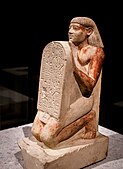
Kneeling portrait statue of Amenemhat holding a stele with an inscription; c. 1500 BC; limestone; Egyptian Museum of Berlin (Germany)
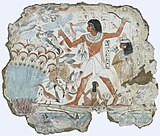
Fresco which depicts Nebamun hunting birds; 1350 BC; paint on plaster; 98 × 83 cm; British Museum (London)

Portrait head of pharaoh Hatshepsut or Thutmose III; 1480–1425 BC; most probably granite; height: 16.5 cm; Egyptian Museum of Berlin

Falcon box with wrapped contents; 332–30 BC; painted and gilded wood, linen, resin and feathers; 58.5 × 24.9 cm; Metropolitan Museum of Art (New York City)


Religious beliefs
Beliefs in the divine and in the afterlife were ingrained in ancient Egyptian civilization from its inception; pharaonic rule was based on the divine right of kings. The Egyptian pantheon was populated by gods who had supernatural powers and were called on for help or protection. However, the gods were not always viewed as benevolent, and Egyptians believed they had to be appeased with offerings and prayers. The structure of this pantheon changed continually as new deities were promoted in the hierarchy, but priests made no effort to organize the diverse and sometimes conflicting myths and stories into a coherent system. These various conceptions of divinity were not considered contradictory but rather layers in the multiple facets of reality.
Gods were worshiped in cult temples administered by priests acting on the king's behalf. At the center of the temple was the cult statue in a shrine. Temples were not places of public worship or congregation, and only on select feast days and celebrations was a shrine carrying the statue of the god brought out for public worship. Normally, the god's domain was sealed off from the outside world and was only accessible to temple officials. Common citizens could worship private statues in their homes, and amulets offered protection against the forces of chaos. After the New Kingdom, the pharaoh's role as a spiritual intermediary was de-emphasized as religious customs shifted to direct worship of the gods. As a result, priests developed a system of oracles to communicate the will of the gods directly to the people.
The Egyptians believed that every human being was composed of physical and spiritual parts or aspects. In addition to the body, each person had a šwt (shadow), a ba (personality or soul), a ka (life-force), and a name. The heart, rather than the brain, was considered the seat of thoughts and emotions. After death, the spiritual aspects were released from the body and could move at will, but they required the physical remains (or a substitute, such as a statue) as a permanent home. The ultimate goal of the deceased was to rejoin his ka and ba and become one of the "blessed dead", living on as an akh, or "effective one". For this to happen, the deceased had to be judged worthy in a trial, in which the heart was weighed against a "feather of truth." If deemed worthy, the deceased could continue their existence on earth in spiritual form. If they were not deemed worthy, their heart was eaten by Ammit the Devourer and they were erased from the Universe.
Burial customs
The ancient Egyptians maintained an elaborate set of burial customs that they believed were necessary to ensure immortality after death. These customs involved preserving the body by mummification, performing burial ceremonies, and interring with the body goods the deceased would use in the afterlife. Before the Old Kingdom, bodies buried in desert pits were naturally preserved by desiccation. The arid, desert conditions were a boon throughout the history of ancient Egypt for burials of the poor, who could not afford the elaborate burial preparations available to the elite. Wealthier Egyptians began to bury their dead in stone tombs and use artificial mummification, which involved removing the internal organs, wrapping the body in linen, and burying it in a rectangular stone sarcophagus or wooden coffin. Beginning in the Fourth Dynasty, some parts were preserved separately in canopic jars.
By the New Kingdom, the ancient Egyptians had perfected the art of mummification; the best technique took 70 days and involved removing the internal organs, removing the brain through the nose, and desiccating the body in a mixture of salts called natron. The body was then wrapped in linen with protective amulets inserted between layers and placed in a decorated anthropoid coffin. Mummies of the Late Period were also placed in painted cartonnage mummy cases. Actual preservation practices declined during the Ptolemaic and Roman eras, while greater emphasis was placed on the outer appearance of the mummy, which was decorated.
Wealthy Egyptians were buried with larger quantities of luxury items, but all burials, regardless of social status, included goods for the deceased. Funerary texts were often included in the grave, and, beginning in the New Kingdom, so were shabti statues that were believed to perform manual labor for them in the afterlife. Rituals in which the deceased was magically re-animated accompanied burials. After burial, living relatives were expected to occasionally bring food to the tomb and recite prayers on behalf of the deceased.


Comments
Post a Comment