Language
Historical development
| ||||||
| r n kmt 'Egyptian language' in hieroglyphs |
|---|


The Egyptian language is a northern Afro-Asiatic language closely related to the Berber and Semitic languages. It has the second longest known history of any language (after Sumerian), having been written from c. 3200 BC to the Middle Ages and remaining as a spoken language for longer. The phases of ancient Egyptian are Old Egyptian, Middle Egyptian (Classical Egyptian), Late Egyptian, Demotic and Coptic. Egyptian writings do not show dialect differences before Coptic, but it was probably spoken in regional dialects around Memphis and later Thebes.
Ancient Egyptian was a synthetic language, but it became more analytic later on. Late Egyptian developed prefixal definite and indefinite articles, which replaced the older inflectional suffixes. There was a change from the older verb–subject–object word order to subject–verb–object. The Egyptian hieroglyphic, hieratic, and demotic scripts were eventually replaced by the more phonetic Coptic alphabet. Coptic is still used in the liturgy of the Egyptian Orthodox Church, and traces of it are found in modern Egyptian Arabic.
Sounds and grammar
Ancient Egyptian has 25 consonants similar to those of other Afro-Asiatic languages. These include pharyngeal and emphatic consonants, voiced and voiceless stops, voiceless fricatives and voiced and voiceless affricates. It has three long and three short vowels, which expanded in Late Egyptian to about nine. The basic word in Egyptian, similar to Semitic and Berber, is a triliteral or biliteral root of consonants and semiconsonants. Suffixes are added to form words. The verb conjugation corresponds to the person. For example, the triconsonantal skeleton S-Ḏ-M is the semantic core of the word 'hear'; its basic conjugation is sḏm, 'he hears'. If the subject is a noun, suffixes are not added to the verb: sḏm ḥmt, 'the woman hears'.
Adjectives are derived from nouns through a process that Egyptologists call nisbation because of its similarity with Arabic. The word order is predicate–subject in verbal and adjectival sentences, and subject–predicate in nominal and adverbial sentences. The subject can be moved to the beginning of sentences if it is long and is followed by a resumptive pronoun. Verbs and nouns are negated by the particle n, but nn is used for adverbial and adjectival sentences. Stress falls on the ultimate or penultimate syllable, which can be open (CV) or closed (CVC).
Writing
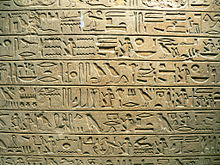
Hieroglyphic writing dates from c. 3000 BC, and is composed of hundreds of symbols. A hieroglyph can represent a word, a sound, or a silent determinative; and the same symbol can serve different purposes in different contexts. Hieroglyphs were a formal script, used on stone monuments and in tombs, that could be as detailed as individual works of art. In day-to-day writing, scribes used a cursive form of writing, called hieratic, which was quicker and easier. While formal hieroglyphs may be read in rows or columns in either direction (though typically written from right to left), hieratic was always written from right to left, usually in horizontal rows. A new form of writing, Demotic, became the prevalent writing style, and it is this form of writing—along with formal hieroglyphs—that accompany the Greek text on the Rosetta Stone.
Around the first century AD, the Coptic alphabet started to be used alongside the Demotic script. Coptic is a modified Greek alphabet with the addition of some Demotic signs. Although formal hieroglyphs were used in a ceremonial role until the fourth century, towards the end only a small handful of priests could still read them. As the traditional religious establishments were disbanded, knowledge of hieroglyphic writing was mostly lost. Attempts to decipher them date to the Byzantine and Islamic periods in Egypt, but only in the 1820s, after the discovery of the Rosetta Stone and years of research by Thomas Young and Jean-François Champollion, were hieroglyphs substantially deciphered.
Literature
Writing first appeared in association with kingship on labels and tags for items found in royal tombs. It was primarily an occupation of the scribes, who worked out of the Per Ankh institution or the House of Life. The latter comprised offices, libraries (called House of Books), laboratories and observatories. Some of the best-known pieces of ancient Egyptian literature, such as the Pyramid and Coffin Texts, were written in Classical Egyptian, which continued to be the language of writing until about 1300 BC. Late Egyptian was spoken from the New Kingdom onward and is represented in Ramesside administrative documents, love poetry and tales, as well as in Demotic and Coptic texts. During this period, the tradition of writing had evolved into the tomb autobiography, such as those of Harkhuf and Weni. The genre known as Sebayt ("instructions") was developed to communicate teachings and guidance from famous nobles; the Ipuwer papyrus, a poem of lamentations describing natural disasters and social upheaval, is a famous example.
The Story of Sinuhe, written in Middle Egyptian, might be the classic of Egyptian literature. Also written at this time was the Westcar Papyrus, a set of stories told to Khufu by his sons relating the marvels performed by priests. The Instruction of Amenemope is considered a masterpiece of Near Eastern literature. Towards the end of the New Kingdom, the vernacular language was more often employed to write popular pieces like the Story of Wenamun and the Instruction of Any. The former tells the story of a noble who is robbed on his way to buy cedar from Lebanon and of his struggle to return to Egypt. From about 700 BC, narrative stories and instructions, such as the popular Instructions of Onchsheshonqy, as well as personal and business documents were written in the demotic script and phase of Egyptian. Many stories written in demotic during the Greco-Roman period were set in previous historical eras, when Egypt was an independent nation ruled by great pharaohs such as Ramesses II.


Comments
Post a Comment