Legacy
The culture and monuments of ancient Egypt have left a lasting legacy on the world. Egyptian civilization significantly influenced the Kingdom of Kush and Meroë with both adopting Egyptian religious and architectural norms (hundreds of pyramids (6–30 meters high) were built in Egypt/Sudan), as well as using Egyptian writing as the basis of the Meroitic script. Meroitic is the oldest written language in Africa, other than Egyptian, and was used from the 2nd century BC until the early 5th century AD.:62–65 The cult of the goddess Isis, for example, became popular in the Roman Empire, as obelisks and other relics were transported back to Rome. The Romans also imported building materials from Egypt to erect Egyptian-style structures. Early historians such as Herodotus, Strabo, and Diodorus Siculus studied and wrote about the land, which Romans came to view as a place of mystery.
During the Middle Ages and the Renaissance, Egyptian pagan culture was in decline after the rise of Christianity and later Islam, but interest in Egyptian antiquity continued in the writings of medieval scholars such as Dhul-Nun al-Misri and al-Maqrizi. In the seventeenth and eighteenth centuries, European travelers and tourists brought back antiquities and wrote stories of their journeys, leading to a wave of Egyptomania across Europe. This renewed interest sent collectors to Egypt, who took, purchased, or were given many important antiquities. Napoleon arranged the first studies in Egyptology when he brought some 150 scientists and artists to study and document Egypt's natural history, which was published in the Description de l'Égypte.
In the 20th century, the Egyptian Government and archaeologists alike recognized the importance of cultural respect and integrity in excavations. The Supreme Council of Antiquities now approves and oversees all excavations, which are aimed at finding information rather than treasure. The council also supervises museums and monument reconstruction programs designed to preserve the historical legacy of Egypt.

Frontispiece of Description de l'Égypte, published in 38 volumes between 1809 and 1829.
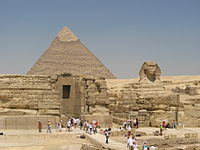
Tourists at the pyramid complex of Khafre near the Great Sphinx of Giza


Comments
Post a Comment